







Global

Compensation for Directors and Executive Officers

Policy on Compensation

Compensation for Directors

  1. Non-executive Directors (including Independent Directors)
    For directors, the compensation standards and compensation system reflect their roles on the Board of Directors and each committee, including the supervision of executive officers' business execution in line with the Company's management philosophy and management strategy, with the aim of achieving sustainable growth and improving corporate value over the medium to long term. The composition consists of basic compensation and long-term incentives, and is determined by the Compensation Committee. The long-term incentive shall be in the form of restricted share-based compensation (RS) to promote the sustainable improvement of corporate value and to encourage the Directors to share values with shareholders through the ownership of shares. Furthermore, the Company pays allowances to the Chairman of the Board of Directors, the Lead Independent Director, the Chairpersons of the Committees and Audit Committee members based on the extent of their roles and responsibilities and the number of hours spent on their execution of duties.

  2. Executive Directors
    The Company pays its executive directors (CEOs and Representative Executive Officers) compensation as executive officers, but does not pay them compensation as directors.

  3. Combination of Compensation
    The combination of compensation for Directors will be as follows:
 Monetary rewardStock compensation (long-term incentives)
 Basic 
Compensation
Short-term performance-linked compensationRestricted stock compensationPerformance-linked stock compensation
Non-executive Directors1.0-0.3-

*The above is the compensation ratio, and the amount paid to each individual will vary.
Compensation for Executive Officers

  1. Compensation System
    For Executive Officers, we have designed a compensation system that encourages them to execute their duties in accordance with our management philosophy and business strategies, and that provides strong motivation for achieving challenging business targets while appropriately controlling risks. The compensation for Executive Officers comprises basic compensation according to the role of President and Representative Executive Officer or each Executive Officer, a short-term performance-linked compensation, restricted stock compensation, and performance-linked stock compensation, and is determined by the Compensation Committee. Executive Officers are expected to play important roles in achieving numerical targets in business execution. Accordingly, the compensation system is designed so that the higher the level of responsibility for business performance associated with a position, the greater the proportion of performance-linked compensation.

  2. Combination of Different Types of Compensation
    The compensation mix for Executive Officers will be as follows:


    Monetary reward

    Stock compensation (long-term incentives)


    Basic Compensation

    Short-term performance-linked compensation

    Restricted stock compensation

    Performance-linked stock compensation

    CEO

    1.0

    0.6

    0.3

    0.3

    Executive Officer

    1.0

    0.6

    0.2–0.25

    0.2–0.25


    *1 The above is the compensation ratio, and the amount of compensation paid to each individual will vary.
    *2 Short-term performance-linked compensation will be paid within the range of 0-200% depending on the degree of achievement of company-wide or business performance targets.
    *3 Performance-linked stock compensation will be paid within the range of 0 to 200% depending on the achievement level of company-wide performance targets.


  3. Compensation Levels
    The basic compensation will be aimed at a level that is comparable to that of rival companies in terms of business and human resources (hereinafter referred to as "peer domestic companies"). We will regularly check the standards of our domestic peer companies, while also taking into consideration employee wage levels (disparities with executives, discrepancies with the general public, etc.) and set compensation levels according to roles.
    The total compensation (basic compensation, short-term performance-linked compensation, restricted stock compensation and performance-linked stock compensation) is set at a level higher than that of peer companies in Japan if strategic and business performance targets are achieved, and lower than that of peer companies in Japan if they are not achieved.

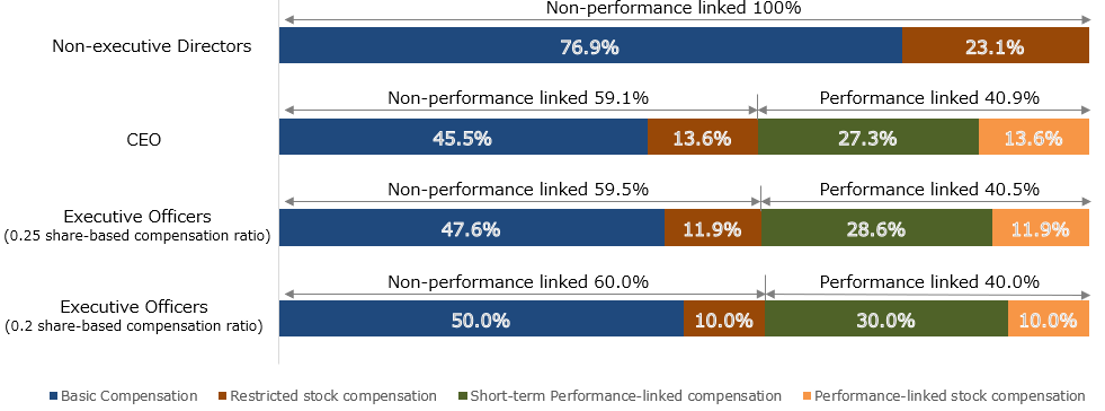
Composition of Compensation Paid to Directors and Executive Officers (If 100% of the target for performance-linked compensation is achieved)

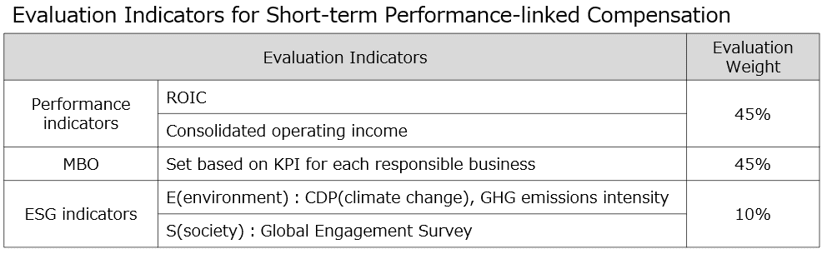
Introduction of ESG Indicators to Short-Term Performance-Linked Compensation

In order to practice advanced ESG management toward a sustainable society through business activities, the Compensation Committee considered it appropriate to strongly motivate directors and officers by reflecting the achievement of ESG goals in their compensation decisions. After extensive discussions, including with reference to the opinions of external experts on global director compensation, the Compensation Committee decided to introduce ESG indicators from the fiscal year ending December 2022.

The evaluation items are: "E" (Environment): CDP (Climate Change) *1 and GHG emissions intensity *2, and “S” (Society): Global Engagement Survey *3 The implementation rate has been set at 10% of the evaluation indicators for short-term performance-linked compensation. The specific evaluation indicators will be continually reviewed going forward.


*1. An ESG rating organization that evaluates strategies for responding to climate change and efforts to reduce GHG emissions.
*2. GHG emissions per unit of revenue (GHG emissions intensity).
*3. Since 2019, the survey has targeted employees of Group companies both in Japan and overseas regarding the current state of engagement in the company and workplace, with a view to achieving the desired image in the medium to long term.

Long-term Incentives (Share-Based Compensation)

In order to prevent the Company’s officers from taking a short-term approach to management and to align their interests with those of shareholders, the Company provides restricted stock compensation and performance-linked stock compensation linked to the Company’s performance.

(a)Restricted Stock Compensation(RS)

In principle, restricted stocks are granted each fiscal year in a certain number according to the role of each officer, etc. of the Company or one of its subsidiaries. For the purpose of promoting shareholdings by directors and employees and enhancing the sharing of value with shareholders, the transfer restriction period shall be from the date of allotment until the retirement of an officer or subsidiary of the Company, and the transfer restriction will be lifted when the officer or other member of the Company or a subsidiary of the Company retires. 

(b)Performance-linked Stock Compensation (PSU)

Performance-linked stock compensation is calculated at follows: in the first fiscal year of the medium-term management plan, the Company presets the standard number according to the roles of Corporate Officers eligible to receive payment, and in the final fiscal year of the medium-term management plan, the Company delivers its common shares to Corporate Officers in accordance with the extent to which consolidated return on invested capital (ROIC), which has been set as targets in the medium-term management plan, has been achieved. The Company will make a monetary payment to the Corporate Officers of an amount corresponding to 40% of the above granted shares.

(i) Performance Indicator
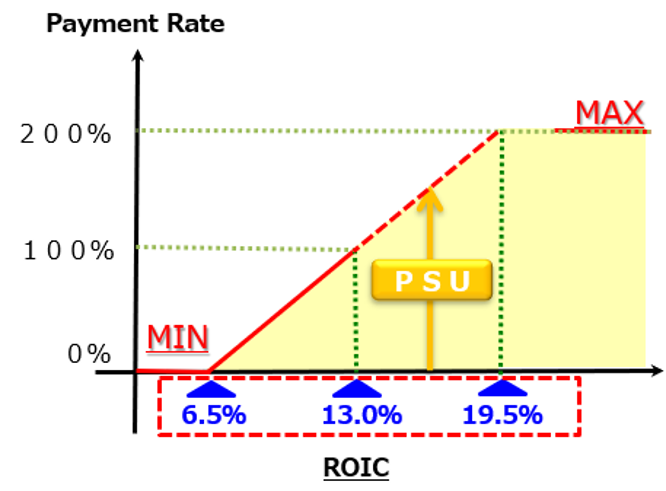
Depending on the degree of achievement of the ROIC target (13%) for the fiscal year ended December 31, 2028, the final year of the medium-term management plan E-Plan 2028, the payment rate is 0% to 200%.

(ⅱ) Reason for Selecting the Indicator
Based on the concept of key indicators under E-Plan 2028, and in light of the Company’s continued commitment to further deepen ROIC-based management following E-Plan 2025, the Company has decided to adopt ROIC, a key management indicator, as the performance indicator.

Method of calculation of the number of shares for payment and individual payment amounts
・Number of performance-linked stock compensation payments by shares (rounded down to the nearest whole unit)
Standard number of units × payment rate × 60%
(1 unit = 100 shares of the Company’s common stock)
・Payment amount of number of performance-linked stock compensation by money (rounded down to the nearest 100 yen)
Standard number of units × payment rate × 40% × share price of our common stock*
(1 unit = 100 shares of the Company’s common stock)
*Simple average of the closing price of our common stock in regular trading on the Tokyo Stock Exchange during the month falling two months prior to the month in which the Board of Directors resolves the allotment for the final fiscal year of the medium-term management plan. 

Payment rate
Payment rate (%) = Consolidated return on invested capital (ROIC) × 15.385-100
Figures are rounded to the first decimal place. However, if the calculation result is less than or equal to 0% the rate shall be 0% (not paid), and if the calculation result exceeds 200%, the rate shall be 200%.
Consolidated return on invested capital (ROIC) = NOPLAT (Net Operating Profit Less Adjusted Taxes) ÷ Invested capital {Interest-bearing debt (average between the beginning and end of fiscal year) + Equity attributable to owners of parent (average between the beginning and end of fiscal year)}

Malus and Clawback Policy

In order to deter misconduct such as legal violations or serious wrongful acts by Directors and Executive Officers, to ensure the soundness of compensation, and to maintain the trust of our shareholders and other stakeholders, the Company has introduced a malus and clawback policy. This policy allows the Compensation Committee to take actions such as the forfeiture or recoupment of compensation in the event of such misconduct.


For more information about Executive compensation, please refer to the following.

Inquiries regarding shareholder and investor information