







To maintain the trust of stakeholders and fulfill our responsibilities as a good corporate citizen, the EBARA Group promotes a shared identity and common set of values among all employees through the EBARA Way and our Code of Conduct. Guided by a commitment to legal compliance, we strive to act with integrity and uphold not only applicable laws and regulations, but also internal policies, social norms, and principles of sound judgment and ethical behavior.
Compliance
Compliance Policy
EBARA Group Code of Conduct
The EBARA Group established the EBARA Group Code of Conduct in 2013 to help fulfill its social responsibilities through its business activities.
The Code of Conduct sets out the fundamental principles of conduct expected of all EBARA Group companies and their officers and employees, including contract employees, part-time employees, and temporary staff. It emphasizes compliance with laws and regulations, adherence to internal policies, the prevention of corruption, and acting with integrity based on high ethical standards.
Responsibility for compliance with the Code of Conduct rests with the senior management of each Group company, who are accountable for ensuring that its principles are fully communicated and embedded throughout their organizations. To reinforce awareness and understanding, all employees participate in annual training on the EBARA Way and the Code of Conduct. The Compliance Promotion Department regularly reviews the Code and related initiatives to ensure their continued effectiveness.
EBARA Group Compliance Framework
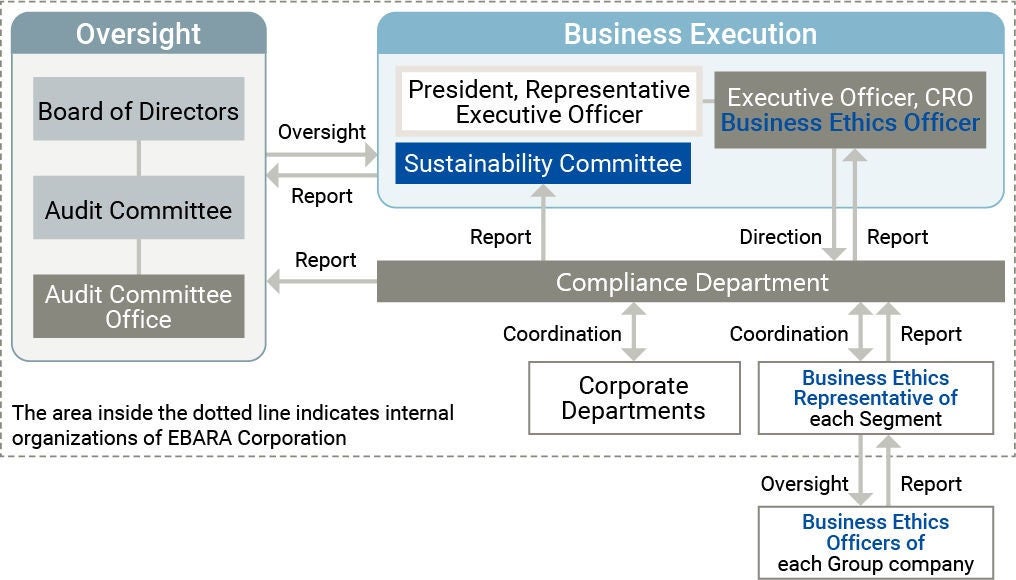
Based on its Compliance Policy, the EBARA Group has established and operates a Groupwide compliance framework under the oversight of the Board of Directors. An overview of this framework is shown in the diagram below.
The Group accepts compliance-related inquiries and reports from a wide range of stakeholders, including officers and employees (including temporary workers), their family members, and business partners.
When a report is received, it is first escalated to the compliance function through the Corporate Ethics Officers of Group companies or the Corporate Ethics Representatives of each Company. The matter is then reported to the Executive Officer serving as Chief Risk Officer (CRO), who acts as the EBARA Group's Corporate Ethics Officer. Under the direction of the CRO, any necessary investigations and corrective actions are carried out.
The compliance function regularly reports on whistleblowing case management, compliance education and awareness activities, and other compliance initiatives to the Audit Committee Office and the Sustainability Committee, which is attended by Directors, and receives appropriate oversight and guidance from the Board of Directors.
Through its whistleblowing and consultation channels, the EBARA Group seeks to identify potential risks as early as possible, prevent or mitigate harm, and promptly address misconduct through effective corrective action.
EBARA Group Compliance Framework
Priority Compliance Strategies
Priority Strategy 1: Embedding a Strong Culture of Compliance
Priority Strategy 2: Strengthening Speak-Up Culture and Risk Mitigation
Priority Strategy 3: Creating an Inclusive Workplace that Respects Human Rights and Diversity
Priority Strategy 1: Embedding a Strong Culture of Compliance
The EBARA Group promotes a shared set of values and standards of conduct across the organization, fostering a culture in which every officer and employee understands and puts compliance into practice in their daily work.
Main Initiatives
| Priority Areas | Key Actions |
| Compliance Education and Awareness | Role-based training, risk-focused training, and e-learning programs |
| Global Compliance Framework | Global training on the EBARA Way and Code of Conduct, conducted annually for all employees; cross-Group information sharing and governance through the CRO Office |
| Fair and Responsible Business Practices | Employee training and operation of a supplier hotline |
| Embedding Compliance in the Workplace | Compliance Liaison Committee activities, case study sharing, and internal awareness initiatives |
Priority Strategy 2: Strengthening Speak-Up Culture and Risk Mitigation
The EBARA Group is committed to strengthening its culture of accountability and reducing risk across the Group by identifying compliance issues at an early stage and ensuring appropriate corrective and preventive actions are taken.
Main Initiatives
| Priority Areas | Key Actions |
| Strengthening Reporting and Whistleblowing Hotlines | Operation of a global hotline accessible to officers and employees across 69 EBARA Group companies in 38 countries; acceptance of anonymous reports; and establishment of the Audit Committee Helpline and an external Antitrust Law Reporting Channel. |
| Strengthening Investigation and Corrective Action Processes | Initiatives to standardize investigation procedures; engagement of external experts; implementation of corrective and recurrence-prevention measures based on investigation findings; and enhanced collaboration with internal audit and internal control functions to improve the effectiveness of corrective actions and preventive measures. |
| Risk Identification and Groupwide Sharing of Lessons Learned | Identification of compliance risks through global compliance surveys and analysis of reports by category and region; focused responses to high-risk areas; and Group-wide deployment of measures to prevent recurrence. |
Priority Strategy 3: Creating an Inclusive Workplace that Respects Human Rights and Diversity
The EBARA Group recognizes respect for human rights as a fundamental element of compliance. In addition to initiatives aimed at preventing harassment and providing effective grievance and consultation mechanisms, we are committed to fostering an inclusive workplace that respects diversity and enables all individuals to thrive.
Main Initiatives
| Priority Areas | Key Actions |
| Addressing Human Rights Risks | Identification and resolution of human rights issues through consultation and reporting channels, including an external grievance mechanism operated by the Japan Center for Engagement and Remedy on Business and Human Rights (JaCER), and reporting of significant matters to the Human Rights Committee. |
| Education and Awareness | Training programs, internal awareness initiatives, and communications from senior leadership. |
| Promoting Diversity and an Inclusive Work Environment | Implementation of a partnership recognition program, diversity and inclusion initiatives, participation in external assessment frameworks such as the PRIDE Index, and engagement with external organizations, including the UN Global Compact Network Japan, to align with international standards and frameworks. |
Compliance Initiatives
The EBARA Group carries out ongoing compliance initiatives to foster a corporate culture that is trusted by society by not only complying with laws and regulations, but also acting with integrity and upholding high ethical standards.
To help every officer and employee understand compliance as a personal responsibility and put it into practice, the Group provides a wide range of education and awareness programs, including level-based and role-based training, e-learning, and global training programs. In addition, compliance-related information is continuously communicated throughout the organization through Compliance Liaison Committee members and information-sharing initiatives on the intranet, helping to embed a culture of compliance across the Group.
The Group also strives to identify workplace issues and potential risks through compliance surveys and the operation of consultation and reporting channels, and uses these insights to support continuous improvement efforts.
Key Initiatives
- Leadership training, management training, and new employee training (for executives, department heads, newly appointed managers, and new employees)
- Role-based compliance training
- Global training for all employees on the Code of Conduct and the EBARA Way
- Compliance surveys
- Internal sharing of whistleblowing and consultation channel activity and trends
- Intranet-based communications and awareness initiatives
- Compliance Liaison Committee system
Compliance Consultation Hotlines
The EBARA Group has established consultation and whistleblowing channels to help ensure fair and ethical business conduct and to enable the early detection and remediation of compliance-related issues.
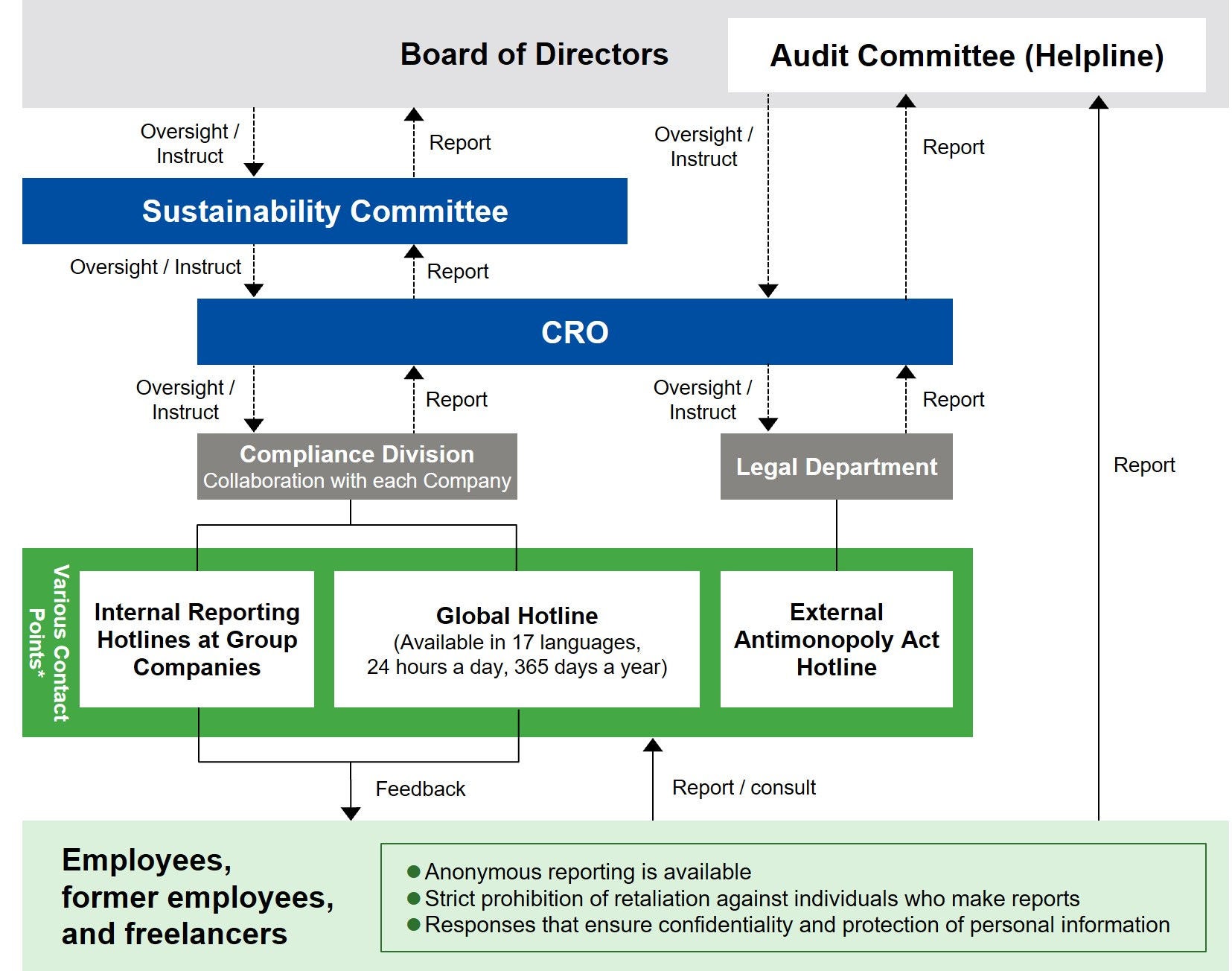
The Group operates a Global Whistleblowing System (Global Hotline) that is available across the organization, providing access to officers and employees at 69 Group companies in 38 countries (as of May 31, 2026). In addition to this centralized system, individual Group companies maintain their own reporting channels, ensuring multiple avenues for raising concerns. The Group also provides specialized reporting channels tailored to the nature of the issue, including the Audit Committee Helpline, which accepts reports directly by the Audit Committee, and an external reporting channel for antitrust and competition law matters.
When a concern or report is received, the matter is reviewed and, where necessary, investigated to establish the relevant facts. Based on the findings, appropriate corrective actions and measures to prevent recurrence are implemented. Investigation results are reported to relevant functions and senior management as appropriate to support ongoing improvement and prevent similar issues from recurring.
Where violations of the EBARA Group Code of Conduct, work rules, or applicable laws and regulations are identified, appropriate disciplinary or other corrective measures are taken in accordance with the employment rules and policies of the relevant EBARA Group company.
The operation of these channels is overseen by the compliance function, which compiles and monitors reporting activity. Through regular reporting to the Audit Committee and oversight by the Sustainability Committee, attended by Directors, the Group works to ensure the proper and effective operation of its consultation and reporting channels.
Compliance Consultation Framework
| Consultation and Reporting Channels for External Stakeholders | Overview |
| Reporting Hotline for Responsible Business Conduct | Accepts reports from all stakeholders regarding specific concerns and risks related to human rights and other responsible business conduct associated with business activities. |
| Business and Human Rights Grievance Mechanism | Accepts complaints from all stakeholders concerning business and human rights issues. Operation of this grievance mechanism is entrusted to the Japan Center for Engagement and Remedy on Business and Human Rights (JaCER). |
| Supplier Hotline | Accepts reports from the Group’s business partners regarding potential violations by the Group of laws and regulations or its Code of Conduct. |
| Job Applicant Hotline | Accepts reports from job applicants and others regarding sexual harassment as required under the Comprehensive Promotion of Labor Policies Act. |
Indicators and Results
Global Whistleblowing System (Internal Reporting System)
| 2024 | 2025 | ||
| Total Number of Reports Received | 57 | 91 | |
|
Category |
Labor-Related Issues | 5 | 13 |
| Harassment | 30 | 56 | |
| Accounting | 0 | 0 | |
| Competition Law | 0 | 0 | |
| Bribery and Corruption | 0 | 0 | |
| Other | 22 | 22 | |
|
Region |
Japan | 45 | 83 |
| APAC (excluding Japan) | 8 | 5 | |
| Americas | 1 | 3 | |
| EMEA (Europe, Middle East and Africa) | 3 | 0 | |
| Cases Investigated (including cases carried over from the previous year) | 91 | 116 | |
| Investigations Completed | 87 | 80 | |
| Cases Confirmed as Misconduct or Policy Violations | 29 | 22 | |
Code of Conduct Training Completion Rate
| 2024 | 2025 | |
| Employees in Japan | 98.6% | 98.3% |
| Employees outside Japan | 97.6% | 98.1%
|


