Global

Climate-related Disclosures​

Climate-related Disclosures

The global environment is the foundation for humanity, all living things, and ecosystems on Earth, and corporate activities cannot continue without a healthy global environment. The Ebara Group recognizes that building a decarbonized society and addressing climate change are critical challenges facing the world and is continuously improving its climate-related initiatives and information disclosure through dialogue with stakeholders.

The TCFD recommendations, which the Company endorsed in 2019, transitioned to "IFRS® Sustainability Disclosure Standard No. 2: Climate-related Disclosures" (hereinafter "IFRS® S2") in 2024. In March 2025, the SSBJ (Sustainability Standards Board of Japan) published its climate-related disclosure standards.
We are currently preparing to ensure compliance with these standards by the time they become applicable to the Company.

Climate-related Disclosure Summary 2026

Climate-related Governance​

The Board's Oversight of Climate-related Matters

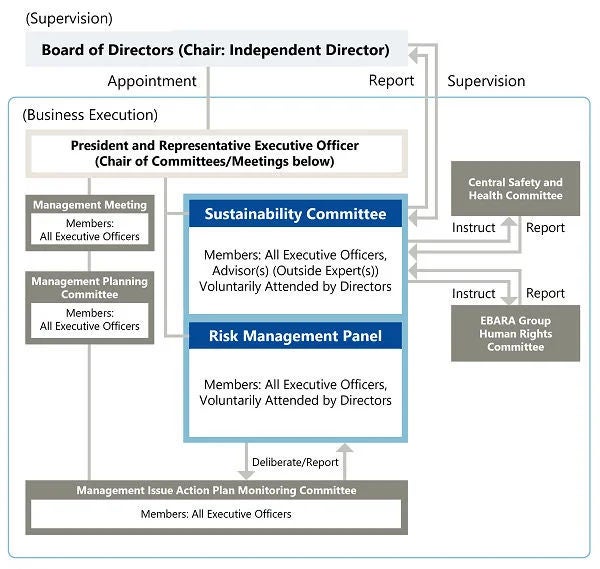
The Board of Directors recognizes that it is a crucial management challenge for our group to enhance “social and environmental value” by implementing advanced sustainability management based on ESG principles and making a sustainable contribution to solving social issues* through our business, while simultaneously enhancing “economic value” through the practice of ROIC management and portfolio management. The Board of Directors formulates basic management policies that look ahead to the long-term business environment, and oversees their continuous implementation, so that our group can generate sustainable growth capital through these practices and connect it to further value creation. We have defined and disclosed this approach in our “Basic Policy on Corporate Governance,” and have established a “Sustainability Committee” on the executive side as a system to ensure its reliable implementation. In addition, the Board of Directors incorporates sustainability issues, including climate change, nature-related issues (water and resources, etc.), human rights, and human capital, into its annual agenda, and regularly allocates sufficient time for multifaceted discussions. By feeding back the results of these discussions to the Sustainability Committee, we have established a mechanism to support the concretization and promotion of executive responses. As part of this effort, we have adopted climate change as an evaluation item for the E (Environment) component of our ESG rating index and introduced a system that links it to the compensation of our directors and executive officers, thereby enhancing the effectiveness of our governance. For more details on sustainability governance, please click here.

Solving social problems : * Promoting decarbonization , Realizing a circular economy , Securing water resources, Responding to increasingly severe natural disasters , Developing advanced industries ,Addressing labor shortages, etc


Promotion of climate-related efforts by the Sustainability Committee

The Sustainability Committee is established as a body to deliberate policies, strategies, goals, and review for activities that contribute to society, the environment, and the sustainability of our group, and to confirm and review the results as part of the business execution. The Sustainability Committee is chaired by the president and representative executive officer and has all the executive officers as its members and external sustainability experts as advisors. The course of action, strategies, risk management, and metrics/targets related to climate are discussed by the Sustainability Committee. We share among all management that our initiatives against climate change are one of the material issues in the Group’s long-term vision, E-Vision 2035. The analysis of climate-related scenarios in each market that include the identification of risks and opportunities related to climate-related strategies is conducted under the responsibility of the presidents of the companies and the results are reflected in each company’s strategies. The results of climate-related initiatives are reflected in executive compensation.
We strive to reflect advice from the directors attending the meetings of the Sustainability Committee in our activities.​
Sustainability Governance

Efforts to manage climate-related risks by the Risk Management Panel (RMP)

We have established a Risk Management Panel (hereinafter referred to as "RMP") to oversee the Group's risk management activities, deliberating and providing guidance and support for improvements. The RMP is chaired by the President, Representative Executive Officers, and made up of all Executive Officers. Based on the regular risk assessments in the RMP, we have identified climate-related risks as a group-wide material risk due to their high potential for occurrence and significant impact. Climate-related risks are assessed as having a high probability and impact, and have been identified as a key risk for the group.

Management Meeting/Management Issue Action Plan Monitoring Committee

When climate-related risks and opportunities are related to asset disposal, investment, and financing, they are submitted to the management meeting.
The financial challenges and nonfinancial challenges including climate change are monitored by the Monitoring Council that manages the progress of the action plan for management challenges to achieve the midterm management plan. ​
The Monitoring Council on the Action Plan for Nonfinancial Management Challenges is chaired by the president, representative executive officer, and CEO. Its meetings are held four times a year and the presidents of each company report the progress of the measures implemented to achieve the nonfinancial targets for the businesses of which they are in charge. The progress of the activities related to nonfinancial matters conducted in all the businesses is reported, and those activities are reviewed at the meetings of the Sustainability Committee held in March and September. The results of the reporting and review at the meetings of the Sustainability Committee are reported to the Board of Directors.

Governance Information (2026)

Filename
Governance_summary.pdf
Size
384 KB
Format
application/pdf

Sustainability Promotion Framework Diagram

Strategy

Our group aims for a carbon-neutral world by 2050, as envisioned by the Paris Agreement, and analyzes the impact of climate-related risks and opportunities on our business for each business segment using the following process. Under the responsibility of the company president, we review the climate-related strategies for the semiconductor manufacturing market, energy market, building and industrial equipment market, water infrastructure market, and solid waste treatment market that each segment faces, on a three-year cycle, coinciding with the formulation of our medium-term management plan. We incorporate countermeasures for significant climate-related risks and opportunities into our business strategy. The analysis results and countermeasures for each business segment are compiled under the company president of each segment, reported to the Board of Directors, and then disclosed.

E-Vision2035 aims to maximize social, environmental, and economic value. Its social and environmental values ​​include a "decarbonized society," a "safe and secure life" that includes protection against flood risks associated with climate change, and an "evolving and prosperous life" achieved through the provision of semiconductor manufacturing equipment that enables the high integration of semiconductors, which are essential for all technologies. All of these are related to climate-related strategies.

Identification and Assessment of Climate-related Risks and Opportunities

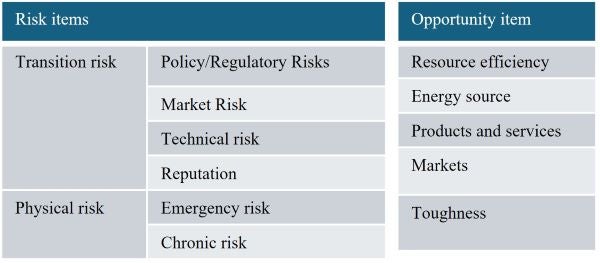
Climate-related risks and opportunities are assessed using the following risk and opportunity categories.

Identification of Climate-related Risks and Opportunities

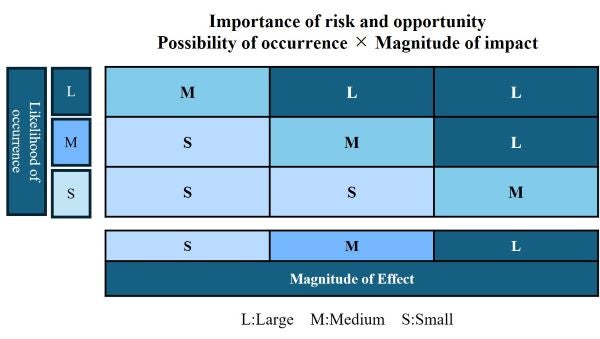
For risk and opportunity items, we extracted elements that may impact our group's business activities for each face-to-face market, referring to the ISSB's industry-specific guidance, and evaluated each on two axes: 'Likelihood (including time frame)' and 'Magnitude of potential impact of risks and opportunities' as large, medium, or small. We reviewed the evaluation criteria and established certain standards for assessing the magnitude of impact on our group's business.

We extracted elements that have a significant impact on our business activities based on the following considerations.

• Likelihood: We captured risks and opportunities that may occur over time.
  • Short-term: Next medium-term period (2026 to 2028)
  • Medium-term: Including the target year of our long-term vision, 2040
  • Long-term: Target year of the Paris Agreement, 2050

• Magnitude of impact of risks and opportunities:
   We set quantitative or qualitative criteria for evaluation.
   As a criterion for quantitative evaluation, we assessed the impact on assumed operating profit.
   Qualitative evaluation was based on the degree of impact on business continuity and expansion.

Significant Climate-related Risks and Opportunities for Our Business

Filename
tcfd_risk_oppotunity.pdf
Size
275 KB
Format
application/pdf

Scenario Analysis

For the risks and opportunities identified in the importance assessment, we predicted how the 1.5°C and 4°C scenarios would impact the business model and value chain.

How will we, our customers, policies/regulations, and suppliers change in a changing business environment? In addition, we created a scenario on the likelihood of new entrants and alternatives appearing.

Impact Predictions on Business Model and Value Chain

Filename
tcfd_scenario.pdf
Size
315 KB
Format
application/pdf

Key Parameters Used in the Analysis (Sources of Scenario Information)

Filename
tcfd_parameter.pdf
Size
360 KB
Format
application/pdf

Impacts of Climate-related Risks and Opportunities on Financial Planning

We assessed the financial impact of significant risks and opportunities.

We prioritized sources of information based on the reliability, versatility, and accessibility of our group's financial information, utilizing data from international organizations (IEA, IPCC, etc.), governments, industry associations, and research companies to estimate the financial impacts of climate-related transition risks and physical risks for each face-to-face market. With the aim of incorporating climate-related strategies into the next medium-term management plan starting in 2026, we reviewed the financial impacts on current business under the 1.5°C and 4°C scenarios in the short, medium, and long term.

Impact of Climate-related Risks and Opportunities on Financial Planning

Filename
tcfd_finance.pdf
Size
329 KB
Format
application/pdf

Strategy based on climate-related risks and opportunities

Aiming for carbon neutrality by 2050, our group has formulated a strategy called E-Visino2035 to realize our desired state in 2035. We have updated our climate-related strategies from 2026 to 2028 by back-casting from our desired state in 2035.

Strategies for Climate-related Risks and Opportunities

Filename
tcdf_resilience.pdf
Size
389 KB
Format
application/pdf

Risk Management

Climate-related Risk and Opportunity Management

Key climate-related risks and opportunities identified for each face-to-face market are managed in the “Non-Financial Management Action Plan” and the “Management Action Plan,” which are action plans within our medium-term management plan. In the three-year medium-term management plan E-Plan 2028, starting in 2026, climate-related risks and opportunities are managed in the “Non-Financial Management Action Plan.”
The “Non-Financial Management Action Plan” is primarily an action plan for managing social and environmental indicators (non-financial). The “Management Action Plan” is primarily an action plan for managing economic indicators (financial). The progress of both plans is monitored by the President and CEO, who chairs monitoring meetings and reviews reports received from the company presidents of each business segment. Furthermore, the Sustainability Committee confirms the progress toward indicators and targets related to E (Environment), S (Social), and G (Governance) across the entire group, and sets the activity policy for our group‘s sustainability management. The "Non-Financial Management Action Plan" includes climate-related indicators.

E-Vision2035 (our desired state in 2035) and E-Plan2028, announced in 2026, reflect the results of our climate-related risk and opportunity analysis, which was reviewed in 2025.

Metrics and Targets

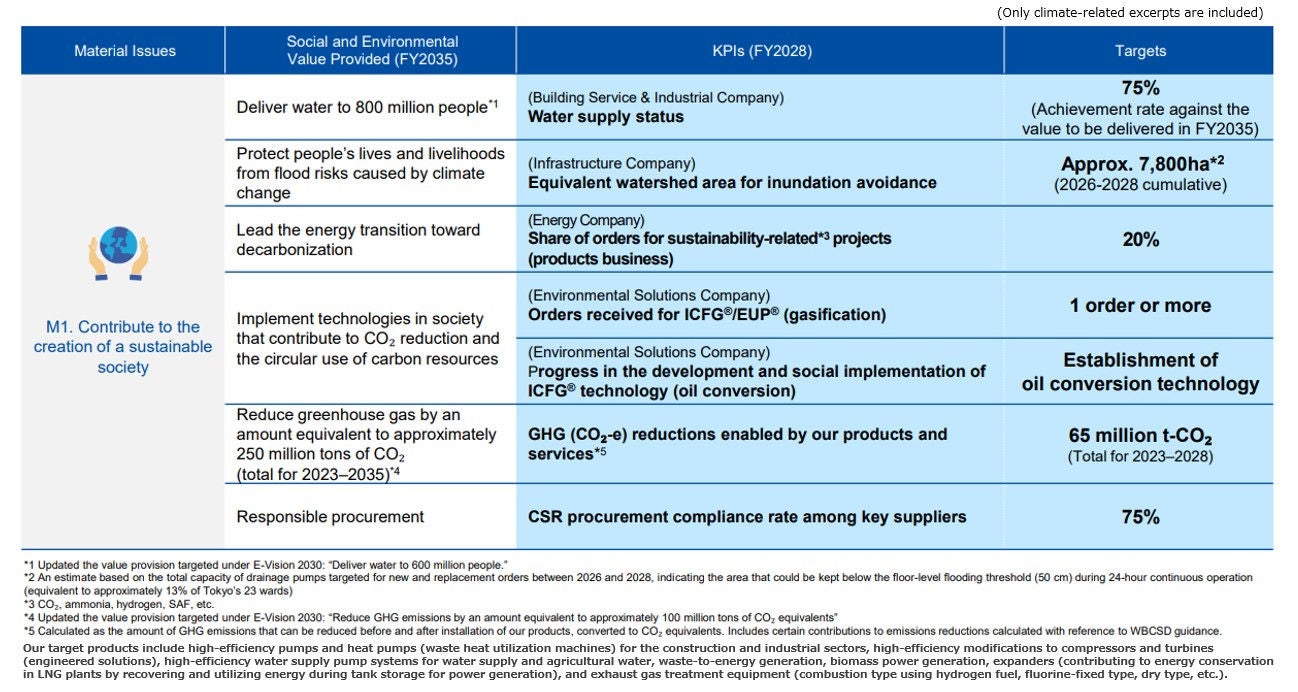
The EBARA Group's goal in "sustainability management" is to create social and environmental value and continuously and directly improve our economic value by addressing the five key issues set forth in E-Vision 2035.

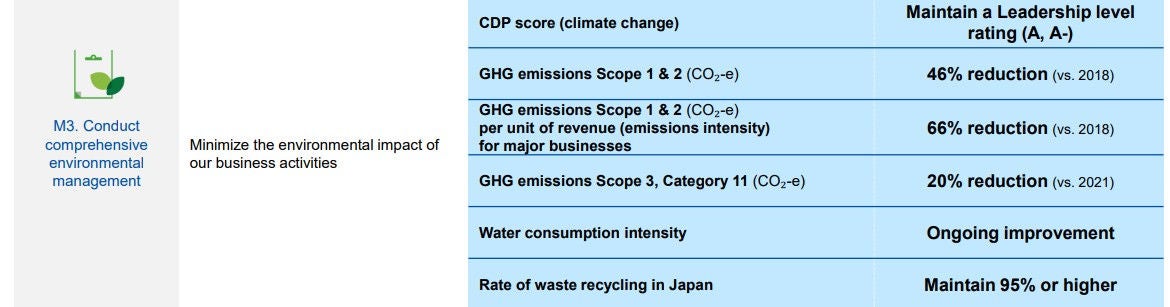
2026~2028 Metrics and targets of Climate related​

Regarding climate-related matters, we have set key climate indicators and targets for 2026-2028 by backcasting from our desired state in 2035. (Excerpt of climate-related targets)

For sustainability inquiries, please contact us here